
Comparisons
Binance Academy Guide: Official Access, Learning Paths, and Safety Checks
Binance Academy offers articles, courses, product guides, and a crypto glossary. This guide shows beginners how to reach the official site, choose the right format, build a focused study session, and verify time-sensitive claims before acting.
If you searched for Binance Academy, you probably want one of three things: a reliable explanation of a crypto term, a structured place to learn the basics, or instructions for a Binance feature. The official Academy can help with all three, but each job calls for a different section—and educational content still needs a date and source check before you act on it.
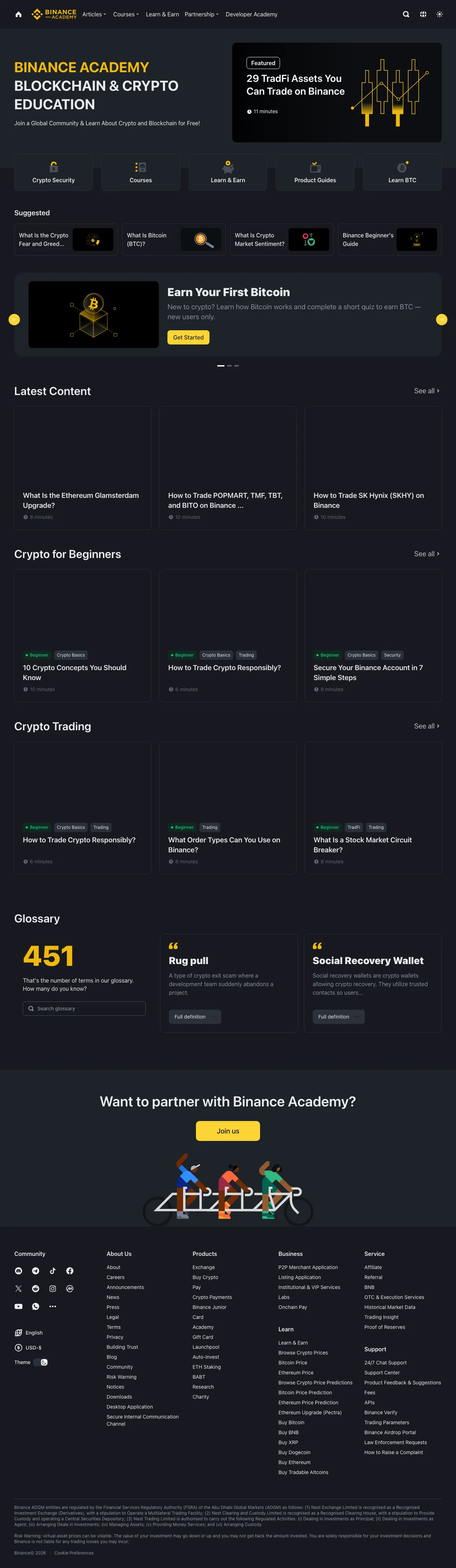
The official Binance Academy English homepage as reviewed on August 10, 2026. Page contents change over time.
What Binance Academy is
Binance Academy is Binance's education hub for blockchain, cryptocurrency, security, trading concepts, wallets, and related topics. Its current English homepage organizes material into several formats, including articles, courses, product guides, beginner collections, and a glossary. The homepage also surfaces difficulty labels and estimated reading times for many items.
That makes the site useful as a starting point, not as a final authority for every decision. Binance Academy's own disclaimer says its material is for informational and educational purposes and may change. It is not investment, legal, tax, or financial advice.
Official starting points:
First, confirm you are on the official site
Open Academy from a saved official link or type the domain yourself. Check the full hostname before reading a product guide, signing in, or following any call to action. The current Academy address may redirect between academy.binance.com and a Binance-owned binance.com Academy path; the important check is that the final hostname is genuinely under binance.com.
Treat these as warning signs:
- a misspelled domain or an extra word before the real-looking name;
- a page asking for a seed phrase or private key;
- a download offered through an unfamiliar file host;
- a promise of guaranteed returns or pressure to transfer funds;
- a support account that contacts you first and sends a special Academy link.
Public educational reading should not require a wallet seed phrase. If your next step is opening an exchange account, pause and work through this exchange setup and security checklist before depositing funds.
Pick the section that matches your question
Use the glossary for one unfamiliar term
Choose the glossary when a page mentions a term such as consensus, gas, staking, or slippage and you need a compact definition. Read the definition, then return to the original material and ask whether the term is being used in the same context. A glossary entry is a map, not a complete risk analysis.
Use articles for a focused explanation
Articles suit questions such as “How does a blockchain transaction get confirmed?” or “What is a cold wallet?” Use the topic and difficulty filters to narrow the list. Before relying on an article, record three details: its update date, its level, and whether it explains a general concept or a specific Binance product.
General concepts often age more slowly. Product screens, fees, eligibility rules, and regional availability can change quickly, so those details require a second check against the current Binance product or support page.
Use courses for sequence
A course or learning track is better when isolated articles leave gaps. Start with a beginner track if ideas such as private keys, block confirmations, decentralized applications, and order types are all new. Complete modules in order, keep a short list of terms you cannot explain in your own words, and use the glossary to close those gaps before moving on.
Use product guides only for the relevant product and region
Product guides can explain where a feature sits and what it is designed to do. They do not guarantee that the same feature, limits, or interface is available in your jurisdiction or account. Confirm the current interface and regional rules before transferring money. If you are still deciding which platform fits your needs, use a criteria-based comparison such as this OKX versus Binance decision framework instead of treating an educational library as an exchange recommendation.
Treat Learn & Earn as a promotion, not a curriculum
Learn & Earn items can add quizzes or rewards to a lesson, but campaigns may be limited by time, region, account eligibility, and remaining rewards. Read the live campaign terms. Do not choose a topic only because a reward is displayed, and never deposit more than you intended merely to qualify.
A practical 30-minute learning session
You do not need to browse hundreds of pages. Use one concrete question and stop when you can answer it plainly.
- Define the question (2 minutes). Write one sentence, such as “What is the difference between an exchange account and a self-custody wallet?”
- Check key terms (5 minutes). Look up no more than three unfamiliar words in the glossary.
- Read one beginner article (12 minutes). Prefer a clearly labeled beginner piece and note its update date.
- Draw the boundary (5 minutes). Write what the article explains and what it does not prove. For custody questions, our guide to an exchange account versus a self-custody wallet can help you compare responsibilities without assuming one answer fits everyone.
- Verify one action-sensitive claim (5 minutes). For fees, limits, tax, legality, or product availability, open the relevant current first-party product page or regulator guidance.
- Summarize (1 minute). If you cannot explain the answer without copying a paragraph, you have found the next gap to study.
This routine keeps the session tied to a real question and reduces the temptation to mistake recognition for understanding.
How to judge whether an Academy page is enough
Use this four-part check before acting:
| Check | What to look for | What to do if it fails |
|---|---|---|
| Date | Publication or update date | Search for a newer official source |
| Scope | General concept or Binance-specific procedure | Verify product procedures in the live product/help center |
| Jurisdiction | Country-specific rules or eligibility | Check your regulator, tax authority, or current regional terms |
| Evidence | Links to primary documentation or clearly stated assumptions | Treat unsupported claims as a starting point, not a decision basis |
No single educational article can tell you whether a volatile asset suits your finances. It also cannot replace professional advice on tax, law, or accounting.
Common mistakes to avoid
Reading only the title. Crypto terms are often overloaded. Read the definition, examples, and limitations before reusing a claim.
Following an old screenshot exactly. Navigation labels and button locations change. Use screenshots to understand the workflow, then match it against the live interface.
Confusing education with endorsement. A lesson about a token, strategy, or product does not make it suitable or safe.
Skipping custody basics. Before transferring assets, know who controls the private keys, how recovery works, and what happens if access is lost.
Using a promotion as proof of quality. Reward eligibility says nothing about an asset's risk or long-term value.
Quick answers
Do I need a Binance account to read Binance Academy?
Many public articles and glossary pages can be read without signing in. A course feature, certificate, quiz, or reward campaign may have separate account and eligibility requirements; check the live page before providing information.
Is Binance Academy financial advice?
No. Its official disclaimer describes the content as informational and educational and says it should not form the basis of an investment decision.
Can I rely on an Academy product guide step by step?
Use it to understand the intended workflow, but compare it with the live interface and current regional terms. Fees, limits, availability, and screen labels can change.
What should a complete beginner study first?
Start with blockchain transactions, wallets and private keys, account security, scams, and the difference between market and limit orders. Learn the mechanics before researching individual assets.
Bottom line
Binance Academy is most useful when you arrive with a specific question, choose the matching format, and verify anything that affects money, account security, or legal obligations. Bookmark the official entry point, use the glossary to remove vocabulary gaps, follow a beginner sequence for fundamentals, and treat every time-sensitive product claim as something to recheck before acting.
Sources reviewed August 10, 2026: Binance Academy homepage, article directory, beginner learning materials, and official Academy disclaimer. This article is independent editorial guidance and is not affiliated with or endorsed by Binance.