
Fees & Savings
OKX Perpetual Funding Fees: Check the Rate, Settlement Time, and Payment History
Holding an OKX perpetual position? Learn when funding is paid or received, how to estimate one settlement, where to check the live rate and countdown, and how to reconcile the actual record.
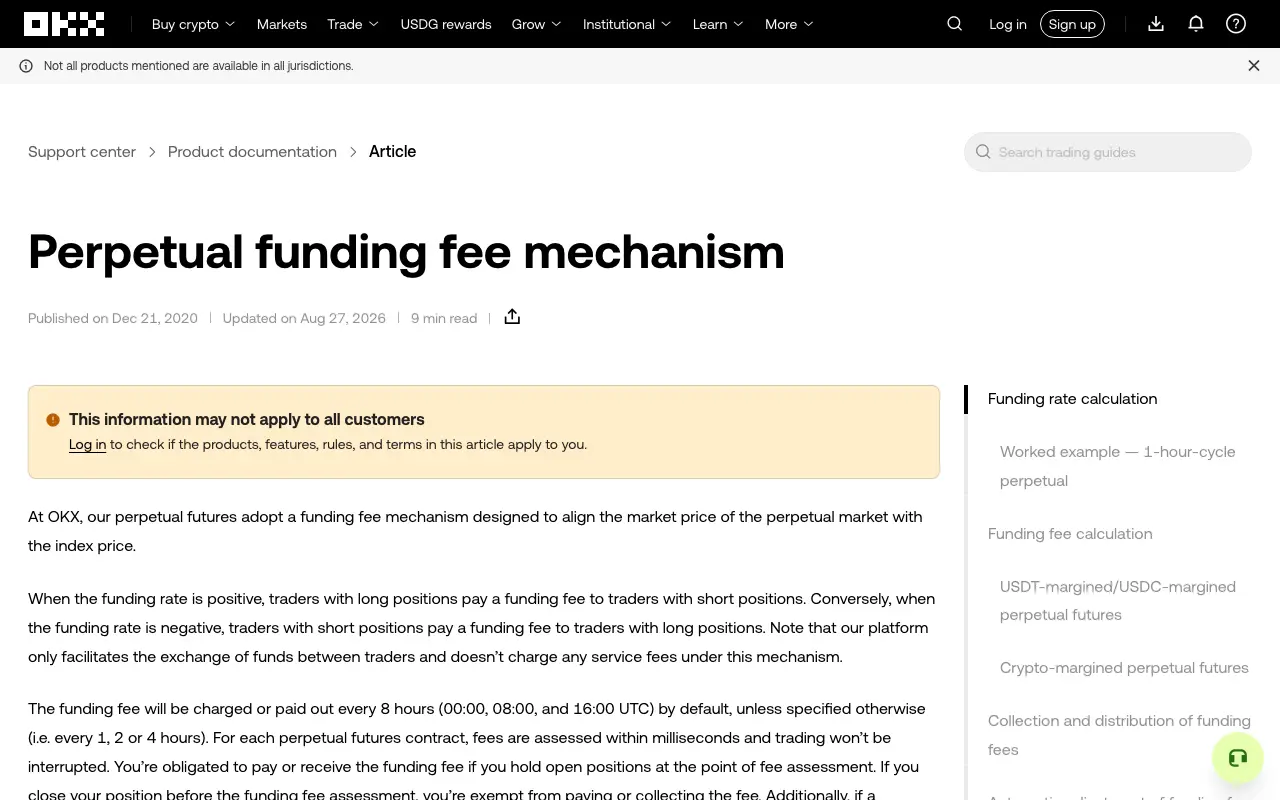
If you hold an OKX perpetual futures position, the funding rate can change what you pay or receive at the next settlement. Check the rate and countdown for the exact contract, estimate the payment from your position value, then compare your estimate with the funding entry in trading history. This guide is for readers reconciling a position or checking its holding cost; it does not predict the next rate or recommend opening a trade.
The public OKX funding mechanism, captured October 1, 2026 without signing in. The page warns that product rules may not apply to every customer; check the contract shown in your own account.
What the funding rate means
A perpetual contract does not have a regular expiry. Funding is a periodic transfer between long and short position holders that helps keep its market price near the underlying index. Under OKX's current funding rules, a positive rate means longs pay shorts; a negative rate means shorts pay longs. At zero, there is no funding transfer for that assessment. OKX says it facilitates the transfer rather than keeping a funding service fee.
Funding differs from the maker or taker fee charged when an order fills. Opening and closing fills can have trading fees even if you hold no position at a funding assessment. Conversely, a position still open at assessment can have a funding payment without a new trade. For a worked calculation of the execution charges, see our OKX spot and futures trading-fee guide.
Check the next rate and time for your contract
In the OKX app, the official funding FAQ directs readers to Trade → Futures → the perpetual pair → Candles → Info → Funding rate. It describes a rate, cap or floor, countdown, and funding period there. On the web, choose the perpetual pair under Trade → Futures, then find Funding rate / Countdown near the top; the FAQ says the Advanced view may be needed if that panel is hidden. Menu labels and access can vary by region and app version.
Read four items together: the exact contract, whether the rate is positive or negative, the next assessment time, and the period to which that rate applies. Do not copy a rate from another pair or from an old screenshot. OKX says the rate used at assessment is the most recent calculation from the preceding minute, so a displayed figure earlier in the period is an estimate rather than a guaranteed final payment.
OKX's mechanism document describes an eight-hour default at 00:00, 08:00, and 16:00 UTC, with some contracts assessed every one, two, or four hours. The schedule and cap or floor can change with market conditions. Follow the live countdown for the contract instead of assuming that every perpetual settles three times a day.
Estimate one funding payment without confusing margin and exposure
The basic calculation is position value × funding rate. For a USDT- or USDC-margined perpetual, OKX defines position value using contract count, size, multiplier, and mark price. A crypto-margined contract uses a different position-value formula and can settle in the coin; use that contract's specifications before combining figures in different units.
Consider a deliberately hypothetical USDT-margined position worth 4,000 USDT at assessment. If the rate were +0.015%, the transfer would be 4,000 × 0.00015 = 0.60 USDT: a long would pay and a short would receive. At −0.015%, the direction would reverse. These are arithmetic examples, not a current OKX quote or a real customer result. The amount is based on position value at assessment, not simply the margin you deposited.
Estimate each assessment separately if you hold across more than one. Both the position value and rate can change, and a partial close changes the remaining exposure. Do not multiply one displayed rate by an assumed number of days and treat the result as a bill. Also keep funding separate from entry and exit trading fees, spread, and any liquidation risk.
Why a payment appears—or does not
According to OKX's funding mechanism, you pay or receive funding only if the position is open when that contract is assessed. Closing before assessment means no transfer for that cycle. The assessment itself may take up to a minute, so a trade placed close to the displayed time can still be included while processing finishes. Check the actual record rather than inferring eligibility only from the clock on your device.
A positive rate does not mean that every account pays: the direction of your position matters. Nor does receiving funding imply the position was profitable overall. A price move and trading fees can outweigh the transfer. Funding deducted from account equity may also affect available margin, so review the position's risk display rather than treating a small projected funding receipt as free income.
Find and reconcile the actual funding record
The OKX funding FAQ gives this app path: Assets → History → Trading → Trading history, then filter Instrument: Perpetual and Type: Funding rate. On the web it lists Assets → Order center → Trading history, with the same instrument and type filters. Look for Funding fee expense or Funding fee income, and record the contract, timestamp, currency, and signed amount. If your interface differs, follow the current History and filter labels shown in your account.
To reconcile a difference, check in order: (1) whether the position was open at assessment; (2) its direction; (3) the contract's actual rate and interval; (4) position value and settlement currency; and (5) whether you are comparing a funding entry with a separate trade fee. Our guide to fee history and statement exports explains how to keep per-fill charges and longer records organized. If an entry still cannot be explained, use the official support route with the contract and timestamp, while hiding account identifiers and other private data in any screenshot.
A limit order is not automatically a maker fill, and maker or taker status does not determine the funding direction. If that part of your total cost is unclear, see how limit and market orders differ.
Sources checked October 1, 2026: OKX's funding mechanism and funding FAQ. Product availability and rules depend on jurisdiction and contract. Perpetual futures are leveraged products with substantial loss risk; this article is educational, not trading advice.